

Why We Are Building Anchor Score
The origin of Anchor Score. Release 001, Anchor Score Knowledge Centre.
29 September 2026
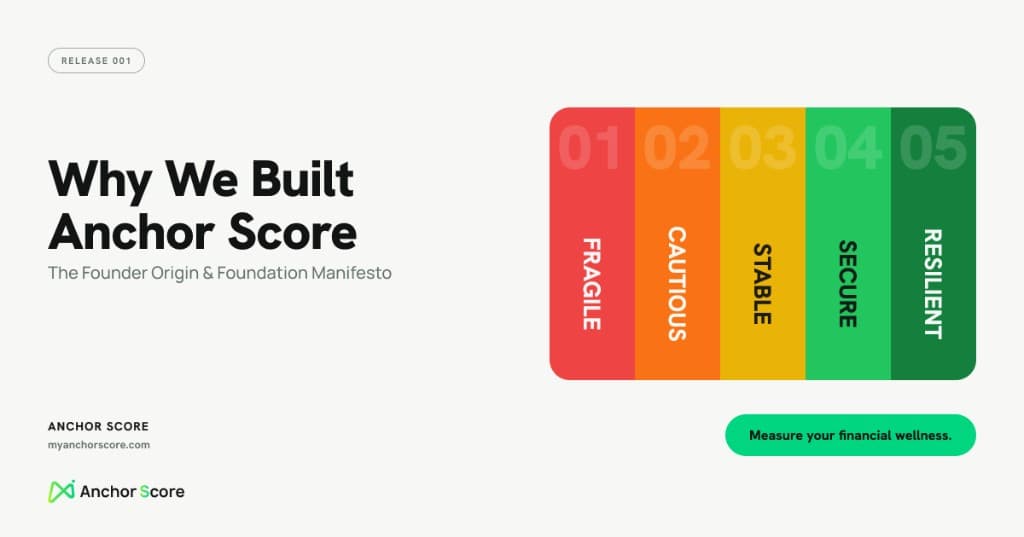
Most of our financial lives can be put into numbers: salary, expenses, savings, investments, credit score. Ask a simpler question, though, and the numbers stop helping. How financially well are you? Most people have never had a clear answer. Anchor Score began with that gap, before there was an app or a product.
The question
Your salary is a number. So are your expenses, your savings, your investments and your credit score. We have a number for almost every part of our financial lives.
But none of them answers how financially well you are. I don't think that's because people haven't thought about it. I think the thing that would answer it has never really existed.
What I kept seeing
I have spent a long time in the financial ecosystem: financial markets, wealth management, insurance, mutual funds and sub-broking. Over those years it got much better at producing information. There are more products and more data, and the digital infrastructure is better. Account Aggregator now makes it possible to bring someone's financial information together, and AI is opening up more possibilities on top of that.
Through all of it, one question stayed hard to answer: what does all of this add up to for the person living that financial life?
Numbers without a picture
Someone can earn well and still have very little cushion. Someone can invest for years and still be exposed when something goes wrong. Someone can save consistently and have no real idea whether the structure they're building is strong enough.
The numbers were there. The picture wasn't.
Income, savings, net worth, investments and credit are all useful measures. Each answers a narrower question than the one I cared about. None of them tells you whether the pieces hold together, or what would happen if your circumstances changed. That was the gap I wanted to work on.
Having money and being prepared
The question I kept coming back to was how prepared you are. That is different from how much you earn or own. It asks whether the financial life you're building has enough structure to hold when things change.
That is what I mean by financial wellness: the health of your financial life, and whether what you do with your money builds stability and readiness over time. Anchor Score exists to make that readiness measurable.
Why we start with the emergency fund
Financial wellness is a broad idea, and the first thing we built around it had to be specific. We started with Financial Security, and within that, the Emergency Fund.
An emergency fund is not all of financial wellness, and Anchor Score is not an emergency-fund company. It is a practical place to begin. You look at what you have today, see where you stand and identify what's missing. Then you build it, strengthen it over time and maintain it as your life changes.
That sequence is the framework we work from: Measure, Build, Strengthen, Maintain.
A language for progress
Financial foundations take time to build, and financial lives don't move in straight lines. We needed a way to describe where someone stands without turning financial wellness into a verdict.
So there are five Anchor States: Fragile, Cautious, Stable, Secure and Resilient.
They are not grades, and they say nothing about someone's character or worth. They describe a position. You can move forward, and you can also move backwards when life changes. That's normal. The point of measuring is to make your position visible so you can see what to build next.
Why a score
Progress is hard to understand when you can't see it. We wanted people to have something they could come back to and watch change as their financial lives changed.
Anchor Score uses a scale from 50 to 900. We chose a range that feels familiar in India's financial ecosystem while letting Anchor Score carry its own meaning. The score tells you where you stand, and the State gives that number context.
Why "Anchor"
The name came after a lot of iterations. We looked at other options, but nothing felt fundamental enough. Anchor did.
An anchor gives you a foundation, but it isn't about staying in one place. It gives you the stability to move. Most of us want to take risks, build things and go further, and the longer the journey, the more the foundation matters. When the anchor is strong, you can take the ship a long way.
Where this is meant to go
I want Anchor Score to become more than something people open on their phones. I'd like the way of thinking behind it to become a habit: know where you stand, build what's missing, strengthen what you've built, maintain it as life changes. If Anchor Score becomes the tool people use for that, good. The deeper success would be people thinking about their financial lives this way without needing us.
That is also why we start with the person and not the product. Financial technology often begins with a mutual fund, a policy or a loan. We want to begin with someone's position: what's working, what's missing, what needs building. Products can be useful inside that journey, but they shouldn't define it.
Measurement and action
Anchor Score is designed to measure. Where it makes sense, the surrounding ecosystem can help people act on what the measurement shows, through financial products and infrastructure.
The two are connected, but they are not the same thing. We will add capabilities as the product matures.
A framework that can grow
People have families and responsibilities, and things happen that nobody planned for. Financial resilience matters because life has to carry on when circumstances change. Over a long enough horizon, that becomes a question of continuity and, eventually, legacy.
I also don't want Anchor Score to be valuable only because one company owns it. If the framework works, its way of describing financial readiness should be useful beyond the company that created it. Different people will need different journeys, institutions will use different products, and technology and the ecosystem will keep changing. The framework should be able to grow with all of that.
What we are not claiming
Everything in the last two sections is long-term ambition, and none of it describes what exists today. We are not going to pretend things are built when they aren't. We won't announce later stages while we're still working on the first one. We won't manufacture testimonials or outcomes, and we won't create urgency around people's financial lives to push them into acting.
And if someone has to use their emergency fund when life happens, that is not a failure. It's what the fund is for. The financial journey has to work in the real world, which is messy.
Building in public
Here is where we actually are. The website is live. The Knowledge Centre is being built. The first Emergency Fund journey is being built, and the measurement framework is still being developed. The ecosystem will grow as the product grows, and the people who use Anchor Score will show us what needs to improve.
We don't have to pretend we've solved everything on day one. We can build, measure, learn and improve in public: reality first, then measurement, then learning, then improvement.
Back to the question
I started by asking how financially well you are.
Anchor Score exists because I believe that question deserves a real answer, and that financial wellness can be made measurable.
Underneath the score and the States is something more human: a foundation strong enough to support the life you're trying to build.
I don't know exactly what Anchor Score will look like in ten years. I do know what I want to build toward: a world where people don't have to guess whether their financial lives are working.
That's why we are building Anchor Score.
And this is where we're starting.
Mustafa Nazar
Founder, Anchor Score

Mustafa Nazar
Founder & CEO, Anchor Score
Financial Wellness has never had a Number. We are Building One | AMFI Registered (ARN-318892)
LinkedInAnchor Score
Financial wellness & readiness infrastructure helping you measure where you stand and build what comes next.
LinkedIn